AOT Logo

Call 619.291.3700

Visit AOT on Facebook View my LinkedIn Profile Follow AOT on Twitter Subscribe to AOT\'s RSS Feed
  • Home
  • Business Consulting
    • Business Health CheckUp
    • Business Planning
    • Management Retreats
    • Marketing Strategy
    • Client Advisory Boards
    • Budgets and Profit Improvement Planning
  • On Target Program
    • Profit Planning Class
    • On Target Business Success Program
  • Coaching
    • Customized Coaching Options
    • Coaching Skills Training
  • Training
    • Phone Right Communications Training
    • Effective Financial Management
    • Towards Awesome Service
    • Coaching Skills for Managers
  • Speaking
  • Blog
  • About Us
    • Testimonials
  • Contact Us

Archive for Business Strategy

Best Business Practice Guide

Posted by Linnea Blair on
 10/20/2020

Do you run your business using best business practices? You probably have a feel for some best business practices if you have been in business for a while. But chances are you are paying attention to some areas more than others.

Over the years that I have worked with small to medium sized businesses to help them grow, not just in terms of top line and bottom line revenue, but also in terms of running a more professional business, I’ve developed some guidelines in several key areas for what I call an “On Target Business”.

Characteristics of “On Target” business owners: They spend time working ON the business, not just IN the business. In other words, they spend time in strategic planning and implementation on a regular basis. They are leaders who have a vision for themselves and for their business over the short and long term. They are known for their integrity in dealing with customers, employees and business partners. They are accountable to their own goals and to what they’ve agreed to do for their company. They apply best business practices. They are growing personally and professionally. They are committed to excellence in the products or services they provide. Finally, they have an extensive network of business contacts, referral partners and advisors.

I’ve identified 5 key areas for business owners to focus on in growing a more professional and sustainable business: Leadership, Finance, Administration, Marketing & Sales and Innovation. For each of these, I’ve included statements that indicate best practice activities and results in each area.

If you’d like to receive my full 5 page Best Business Practices Guide entitled “Put Your Business On Target for Success”, just click here.


Categories : Business Strategy
Tags : Best Business Practices, Business Planning, Business Strategy, Key Performance Indicators, KPIs, Leadership

90 Days to Achievement

Posted by Linnea Blair on
 08/18/2016

I love working with a 90-day framework for goal setting and implementation. Many of my coaching clients both here in San Diego and nationwide are finding that it is easier and more fun to set short-term goals and focus on taking action on a few initiatives from their annual plan every quarter.
Results
You’d be surprised at how much more you can accomplish in a year with this mindset. It’s easy to get overwhelmed if you’re looking at what you want to get done in your business over the whole year. Sometimes it’s even hard to know where to start. Everything can seem like a priority.

Don’t get me wrong. You still want to spend time annually in setting your goals and planning your strategy for the longer term. You’ll also want to create a workable budget/profit plan so you know what numbers you need to hit each month.

But once you’ve done that, divide up your annual goals and initiatives into quarterly segments. Since you’ve created a profit plan, you know what your revenue and profit targets are for the coming quarter. What other metrics do you need to define for the next 90 days? List them out.

What initiatives do you have in your annual plan? For example, you might have some big things like:

  • Develop a Training Program for employees
  • Re-do the company website
  • Implement a CRM
  • Recruit and hire a new office manager

First, prioritize these initiatives to see which ones need to be done first. If your profit plan shows you hiring an office manager in Q1, then that makes it easy to put that in your first quarter. Maybe then having an office manager, you’ll find it easier to have him or her spearhead the implementation of a CRM in Q2, for example. Business cartoon showing people in a meeting, a chart with large $ signs and leader saying, 'who's ready to see what's going to happen in the fourth quarter?'.

Rather than try to start 4 things at once and not get any of them done, you can prioritize and plan, giving you peace of mind knowing that each initiative has its time and place.

Look at your goals for the year. What is the best initiative for you to tackle this coming quarter to make your year a success?

Categories : Business Strategy
Tags : 90 Day Goals, Business Planning, Business Strategy, Coaching, Goals, Quarterly Plan, Small Business Coaching, Small Business Consulting

Profit Planning for 2016

Posted by Linnea Blair on
 11/10/2015

Now is the time to put on your planning hat and craft a workable plan to attain your 2016 goals for your business.

Do you have a goal for what you want to achieve in your business the coming year?
If you do, are you confident that you have a solid plan to make it happen?

Industry DataWhat are your revenue and profit goals?

What will it take to produce those results?

Does it mean an increase in the amount of business you do?

Does it come in part from increased profitability?

Or a combination of the two?

What do you need in terms of people, or technology or infrastructure to ensure your success?

If you’re planning to grow, where is the increase in business going to come from –
new target markets or better marketing to existing customers and markets?

What kind of investments do you need to make to grow?

Does the amount of revenue you’re projecting along with the expected expenses result in a bottom line profit that is acceptable to you? If not, where do we need to rethink? Should we increase prices or work on getting more efficient?

These are all valuable questions to ask yourself in the process.

A detailed and strategic Profit Plan gives you the framework to achieve the success you want for the upcoming year.

Elements of your 2016 Profit Plan

    • Budget to achieve Year 1 of your 3 Year strategic plan
    • Marketing Plan to support your budget and strategic plan
    • Hiring Plan to support budget and strategic plan

    The Profit Plan Budgeting Process
    Review your Vision and Strategic Plan
    Determine your revenue and profit goals for the year
    Project labor hours and personnel needs
    Project labor cost
    Use your 2015 Monthly Profit & Loss Report as a guide to project expenses
    Evaluate other projected changes in expenses
    Create your Budget using a template
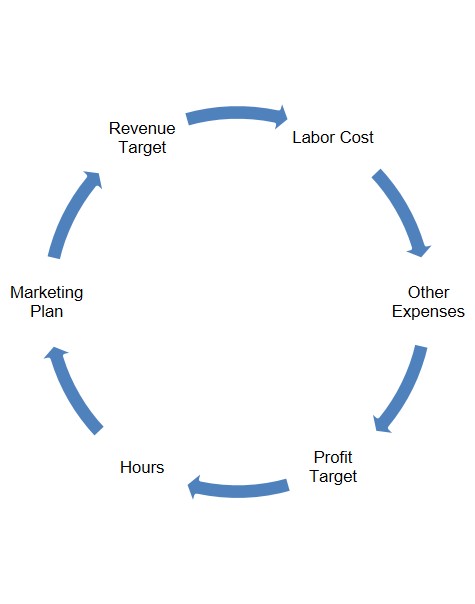
    Re-evaluate all components using the design spiral below
    Design Spiral
    As you move around the design spiral, ask yourself the following questions?

    • What is the revenue target?

    • What is the projected cost of labor?
    • What other expenses need adjustment?
    • Does the budget achieve the profit target?
    • Do the projected hours or number of employees support the revenue target?
    • Can I hire the employees I need?
    • Should the revenue target be adjusted?
    • Does the marketing plan support the revenue target?

    This process will make you take a look at and create or fine-tune your marketing plan and your hiring plan.

    Need help? Here are 3 ways I can support you if you don’t want to go it alone:

    • 4 Week Profit Planning Class
    • One to One Profit Planning Package
    • Budget Templates

    P.S. If you’re already a client on a monthly coaching plan, the one to one Profit Planning and custom budget templates are all included for you!

Categories : Business Strategy

Stages of Business Growth:Cracking the Million Dollar Code

Posted by Linnea Blair on
 03/20/2014

I recently presented this education session at the Painting & Decorating Contractors of America (PDCA) Expo in Reno on March 13, 2014

Stages of Growth: Cracking the Million Dollar Code

Not everyone wants a business that grosses a million (or multi-million) dollars a year. Some business owners prefer more of a “lifestyle” business just big enough to pay you a comfortable income without a lot of complexity. This education session is for Painting Contractors who have a bigger vision and who want to grow an organization with a structure that gives you more freedom and more options for your future. Options like being able to delegate key activities of the business so you can take more time away from the business without losing money. How about creating a business that is more saleable? Or one that continues to pay you in retirement after you’ve stepped back from an active role in the company.
How do you get there? Many contractors struggle with getting past the stages of growth to get you to that Million Dollar mark and beyond.


Stages of Growth: Cracking the Million Dollar Code from Linnea Blair

In this workshop we explored:

  • The stages of growth that Painting Contractors work through on the way to reaching certain levels of income and business maturity.
  • Mapping out a structure to achieve your vision at each stage of your growth
  • Best business practices for Painting Contractors who want to grow a successful and professional company
  • Creative ways to achieve results by not doing what everyone else does

What is keeping you from achieving your growth goals? We explored some common stumbling blocks, and suggest ed strategies and actions you can take to increase your ability to successfully evolve your business to achieve your vision.

Have Questions? Call 619-291-3700.

Categories : Business Strategy

Small Business Success Tips for 2014

Posted by Linnea Blair on
 01/23/2014

Every January I publish my success tips for small business owners. I hope these will give you inspiration and guidance for growing a sustainable business and achieving your goals for 2014 and beyond!

Look for your Vision
2014 Small Business Success Tips
Many business people think of Vision as some kind corporate-speak “vision statement” that you put together via committee and frame on the wall and put on all your marketing collateral. When I talk about Vision, I mean your personal well-thought out vision of what you want for your own life this year, 3 years from now, and even 10 or more years from now (if you can think that far!). Once you are clear about what you want for your personal life, what is your vision for your business to support your personal vision and those of the other stakeholders in your company? Draft out what your company vision looks like for this year, and at least 3 years out.

Make a Plan

With your company vision in hand, now make a strategic plan to achieve that one year vision. Looking ahead to your 3 year vision, make sure to include in your one year plan the ability to get one third of the way there…or some other appropriate “way point” that you can measure progress against. Your strategic plan will include how to generate more business (marketing), how to improve your profit margins (internal systems and processes) and how to increase capacity to serve a growing business (organizational infrastructure/human and financial capital).

Implement

Now you need to actually do something with your plan. Don’t let it gather dust on the virtual shelf! Break out your strategic plan into action steps with due dates and people assigned to take ownership of each initiative. Sometimes some items can be outsourced if you don’t have capacity or expertise within your company to take them on.

One of the biggest barriers to implementation for small business owners is to commit to making time to drive their strategic plan forward. But it is absolutely critical to the successful achievement of your goals. Put time in your calendar to work on specific initiatives or to meet with the people to whom you have delegated action items. Honor your “working ON the business” appointment times just as much as you honor appointments with your clients and prospective customers.

Track your Progress

It has been said, “What you can measure, you can manage”. Check in regularly with your progress on your initiatives. Set benchmarks and goals and measure where you are at least monthly and in some cases weekly. Have targeted meetings with key people to make sure everyone is moving forward and executing their part of the plan effectively.

Stay Accountable

Much like an Olympic athlete stays focused on practicing every day to be the best in the world, if you really want to achieve your goals for 2014, you also must be fully committed to executing your plan. When you really resonate with your vision, it’s easier to stay committed to taking the actions you know you need to take – so make sure your vision fits! But all of us need support at times to stick with our plan. There are many ways you can support your success: Form teams in your company, get outside advisors, join a peer group or just find a like-minded business owner friend to be your “accountability partner”.

My 2014 Business Success Tips just scratch the surface of how to achieve your business goals this year, but I hope you find a nugget or two that will help you take action on the opportunities you have this year to advance in the direction of your vision. Here’s to your success!

Categories : Business Strategy

Plan or Procrastinate – The Future is Yours

Posted by Linnea Blair on
 12/12/2013

Your Exit Strategy: Plan or Procrastinate

I recently presented this overview webinar to the PDCA Contractor College. Below is a synopsis and slides from the program.

Did you know that it typically takes five to ten years to prepare a business for sale or transition? Most business owners think that planning their exit from the business is something that they can think about later. Some may have the idea that they will pass their business on to their children or perhaps a key employee. Others may think about selling the business to a third party or worst case scenario, just liquidating the business.

All of these alternatives need a sufficient degree of planning in order for you to exit the business on your terms and with your retirement income secured.

Your exit strategy: Plan or Procrastinate – The Future is Yours from Linnea Blair

In this overview workshop we explored:

  • Critical questions you need to answer before you can start the transition process
  • The most common options for exiting your business
  • Key considerations when selecting the best exit strategy for you
  • Specific variables that will add value to your business in preparation for sale
  • Essential estate planning considerations for family businesses

In The 7 Habits of Highly Effective People, Steven Covey suggests that we “Begin with the end in mind”. It’s never too early to take that advice when it comes to what you want for your life and your business. It’s unlikely that you want to trust the biggest financial transaction of your life to chance. Take time now to start the planning process to develop the structure, systems and people you need to make a successful transition to the next phase of your life.

If this content interests you, feel free to contact me. I can put you in touch with exit planning professionals in all the areas mentioned in the presentation. As always, I provide a 30 minute complimentary consultation with real advice, not just a sales pitch.

Categories : Business Strategy

10 Tips for a Successful 2013

Posted by Linnea Blair on
 01/16/2013

2013 SuccessLast year I wrote 10 Tips for a Successful 2012 and this year I’m following up with some tips for a successful 2013 based on my thoughts about the current business climate and my experiences as a business coach in working with business owners over the last year. I trust you will find one or two of them helpful as you launch a new business year!

  1. Plan
    A successful year starts with a good plan. Review where you want your business (and your life) to be in 3 years or 5 years or 10 years, whatever length of time makes sense to you. Do you want to be doing the same things you are today, or do you want your business and your life to look different 3 years from now? Chances are you do. How does 2013 need to turn out in order for you to be 1 year further on the path to your goal? Create a plan to get there. This includes creating a set of strategies and a profit plan/budget so that you can implement your plan and measure your progress.
  2. Work ON the Business Weekly
    Don’t just wait until you have time to sit down and evaluate where you are and what course corrections you might need to take. You won’t do it very often! Take time each week for strategic planning for both the immediate short term (weekly) and to plan for what you can do this week towards your longer term implementation plan.
  3. Use Your Calendar
    To make your strategic planning and implementation plan work, you need to actually put your “Working ON the Business” time into your calendar. Honor it like you would an appointment with your best client.
  4. Communicate
    Most problems that business owners have with customers, employees and business partners stem from a lack of timely, honest and respectful communication. Learn from your past mistakes and resolve to communicate with others the way you want people to communicate with you.
  5. Have Regular Meetings
    This goes hand in hand with communication. Regular meetings with your management team, your office team, sales teams or other teams in your company are critical to the regular flow of information about customers, employees, projects, initiatives, finances, etc. that keep your business running smoothly. Have an agenda and stay focused on the outcomes.
  6. Review Your Key Metrics Monthly
    If you have a plan, you have goals and numbers to hit: revenue and profit goals, sales goals, hiring goals, productivity goals, debt reduction goals, goals for how much time you want to work (or not work) in the business, and many others. Your internal process and technology systems should allow you to review the relevant numbers easily. How are you doing? What corrective actions do you need to take, if any?
  7. Engage Your Audience
    Customers are more discerning now than ever before. They don’t just want to be marketed to, they want to be engaged, and they want social proof. Building relationships with your customers and prospects is more important than ever in the world where so many of us our living our lives more transparently through social media, and online reviews and recommendations. Showing yourself as a trusted authority in your industry and sharing helpful information with your audience through your own channels and social media channels is very helpful to the process of engaging your market.

  8. Talk With Your Customers
    Make a customer communications plan. This goes along with engaging your target market since your existing or past customers make up the most valuable segment of your audience since they have already purchased from you. Making a customer communications plan can be as simple as deciding how often to contact your customers, what message (or helpful information) you want to send them and how you want to communicate it, whether by phone, in person, email, direct mail or online social media. Talking with your customers can also mean getting their feedback on their experience with you, or how you can help them better. This is an opportunity to ask for public feedback as well in the form on an online review which will help build your social proof with prospective customers.
  9. Take Action
    With all of the things you would like to accomplish in your business, it’s important to chunk your initiatives down into concrete action steps that you can accomplish in a set time frame. That way when you engage in #2 Work ON Your Business Weekly, you know what to work on and when it needs to be done to move you forward in your overall plan. Don’t overwhelm yourself with too many things at once. You want to be able to celebrate small successes and milestones to keep yourself engaged and excited about your progress!

  10. Get Support
    You can’t do it all by yourself! If you have a team of employees or business partners, you can mutually support each other. You can also assemble a team of advisors from outside your company to meet with you periodically – perhaps a trusted friend or family member, CPA, or other business advisors. You can join a peer group that will help hold you accountable to your goals, or you can work with a business coach. There are many opportunities for you to put the structure in place to achieve your goals.

One opportunity to kick start your 2013 is our 10 Week Business Intensive which starts January 29, 2013.

Here’s to your success!

Categories : Business Strategy

January is Work ON Your Business month

Posted by Linnea Blair on
 01/04/2012

Time to Invest in You

Isn't it time to invest in making your business better?

January is an especially good time to work ON your business. For many companies, business tends to slow down in January. Whether or not your business is seasonally slow in the winter time, there is usually a lull right after the holidays. Many consumers of your goods and services may have spent a lot of money during the holidays and now are a bit more dormant than usual.

This is your opportunity! Remember in your busy season when you have all kinds of great ideas about making your business better, but you don’t have time to put them into effect? This is the time to do some strategic planning and put into place some of those missing procedures and systems that will make your business run better next busy season.

It’s also a good time to put together your profit plan and budget for the year and lay out your marketing plan. Remember the all important action plan that will help you detail specific tasks, assign responsibility and set due dates for accomplishment.

Take the time now, and you will reap the rewards all year!
For more ideas, read my 10 Tips for a Successful 2012.

Categories : Business Strategy

Give Your Business a Health Checkup

Posted by Linnea Blair on
 02/04/2011

Have you taken time to review your key metrics for your business lately? Do you know how your business metrics stack up against best business practices? Do you know how the typical performance of other companies in your industry and region compares to your own margins?

Early in the year is a perfect time to get a Business Health Checkup. Usually by February you have finished all your year-end bookkeeping, reconciled all your accounts and made sure your data was accurate so you could send out your 1099s and W-2s. You also have likely created a budget or what I like to call Profit Plan for the new year and you are starting to implement it.

Doing a business health checkup now gives you good information about where your business stands presently and a view of recent performance. What you find in your health checkup report and consultation will give you knowledge, tools and recommendations to make changes that will ensure greater success in working your plan for the coming year.

Find out more about the business health checkup process.

Categories : Business Strategy
Tags : Business Health Checkup, Business Planning, Business Strategy, Finance

Do You Know What Your Competitors Are Doing?

Posted by Linnea Blair on
 11/09/2010

Every business owner should be able to answer with an unqualified “Yes” to the following questions which address the fundamental need for businesses to identify and understand their competition. If you answer “No” to any of these questions, you are probably missing some valuable information that would provide you with a competitive advantage.

  • Do you know who your competitors are? Do you know where they are and how big they are? Would you be aware if any new competitors entered your market?
  • Do you regularly monitor your competitors’ advertising and promotions by looking for their advertisements, visiting their premises and looking at their websites?
  • Do you talk to your suppliers about your competitors and gather information about what they’re buying and what quantities they purchase?
  • Do you encourage your employees to keep an eye on marketing activity by your competitors and pass any good ideas on to you?
  • Do you keep up to date with technological developments in your field and will you know if your competitors adopt new technology into their business?
  • Do you know the statistics of your marketplace – what your share of market is and what market share is held by each of your major competitors?
  • Have you conducted a SWOT (Strengths, Weaknesses, Opportunities and Threats) analysis on your business? Are you prepared to deal with any competitive threats that might be identified?
  • Do you know what opportunities exist for you to grow your business – either by taking business away from your competitors or by expanding into new market areas?
  • Do you know what is happening in the legislative environment that might affect your operations such as new laws relating to workplace safety or product standards that could pose a threat to you or mean that you will have to change the way you conduct your business?
  • Do you regularly research your products or service offerings against those of your competitors? Are you able to respond quickly if you find your product/service offers fewer features and benefits or needs improvement?
  • There can be a lot of work involved in finding the answers to these questions and using them to improve your products or the way you deliver your services. But you also have advocates in your team, whose eyes and ears can also be alert to monitor your marketplace. If you work together with your team you’ll be in a much better position to answer the questions and to create strategies to outclass your competitors. Businesses that know and understand their rivals have a much better chance of being able to withstand competitive onslaughts and to formulate strategies that will win more business than others in its industry.

    Information in this article is sourced from RAN ONE © 2010 Bullseye

Categories : Business Strategy
Next Page »
Sign Up for our Monthly Newsletter

Email:

Recent Posts

  • Business Goals…what Business Goals?
  • Best Time to Make a Business Budget?
  • Budget your vacation?
  • Know Your Numbers – What does it mean to you?
  • Best Business Practice Guide

Categories

  • 6 Advisors
  • Business Operations
  • Business Planning
  • Business Strategy
  • Construction Law
  • Customer Service Systems
  • Employees
  • Employment Law
  • Events
  • Financial Management
  • Human Resources
  • Internet Marketing
  • Leadership
  • Marketing
  • Member Notices
  • On Target Program
  • Personal Growth
  • Productivity
  • Productivity Tips
  • QuickBooks Tips
  • Relationship Marketing
  • Social Media Marketing
  • Uncategorized
  • What's Next?

Archives

  • January 2024
  • November 2021
  • October 2021
  • October 2020
  • January 2020
  • November 2019
  • October 2019
  • September 2019
  • August 2019
  • November 2016
  • August 2016
  • November 2015
  • July 2015
  • June 2015
  • May 2015
  • November 2014
  • August 2014
  • March 2014
  • January 2014
  • December 2013
  • July 2013
  • February 2013
  • January 2013
  • September 2012
  • August 2012
  • March 2012
  • February 2012
  • January 2012
  • December 2011
  • October 2011
  • September 2011
  • July 2011
  • June 2011
  • May 2011
  • April 2011
  • February 2011
  • January 2011
  • December 2010
  • November 2010
  • October 2010
  • September 2010
  • August 2010
  • July 2010
  • June 2010
  • May 2010
  • April 2010
  • March 2010
  • February 2010
  • October 2009
  • July 2009
  • June 2009
  • May 2009
  • March 2009
  • February 2009
  • December 2008
  • November 2008
  • October 2008
  • September 2008
  • August 2008
  • July 2008
  • June 2008
  • December 2007
  • September 2007
  • August 2007
  • November 2006
  • October 2006
  • September 2006
  • August 2006
  • July 2006
  • February 2006
  • November 2005
  • October 2005
  • September 2005
  • August 2005
  • July 2005
  • June 2005

Tags

6 Advisors 90 Day Goals Accounts Receivables Action Plan ADA Advisors On Target Appreciation Bartering Best Business Practices Blog Blogging Borrowing Brand Budget Busget Business Business Finance Business Health Checkup Business Law Business Mistakes Business Operations Business Plan Business Planning Business Strategy Business Valuation Cash Flow Cash Management Charitable Christopher Olmsted Client Deposits Client Retainers Closing Ratio Coaching Cold Calling Cold Calls Collections Communication Company Culture Computers Computer Virus Construction Law Conversion Customer Communications Customer Loyalty Customer Service Delegating Easy Marketing Economy EEOC Email Marketing Email Newsletter Employee Development Employee Expenses Employee Fraud Employee Morale Employee Retention Employees Employment Employment Law Entrepreneur Exit Strategy Finance Financial Management Financial Statements Focus Forecasting Goals Hiring Human Resources Internal Fraud Internet Explorer Internet Marketing Invoices iPad IT Key Performance Indicators KPIs Lawsuit Leadership Leads Litigation Marketing Marketing Strategy Mechanic's Lien Mobile Monitoring Networking Niche Market Non-profit Online Marketing Online Strategy On Target Program Owner Compensation painting contractors Payroll Processing Payroll Service People Development Personal Growth Personnel Management Politics Pomodoro Positive Thinking Productivity Productivity Tips Profit Profit & Loss Profit Plan Project Management Pro Painting Net Quarterly Plan QuickBooks Tips Relationship Marketing Relationships Marketing Retention Retirement Sales Sales Pipeline Sales Receipts search engine marketing Selling Sellling SEO Sexual Harassment Training Small Business Small Business Coaching Small Business Consulting Social Media Strategic Planning SWOT Analysis Team Team Training Teamwork Technology Time Management Trading Services Twitter Webinar Website WordPress
NetworkedBlogs
Blog:
Advisors On Target Business Success Blog
Topics:
business strategy, marketing, internet marketing
 
Follow my blog

Copyright © 2003-2019
Advisors On Target LLC   |   3940 Hortensia Street, #201   |   San Diego, CA 92110  |  619-291-3700

Contact Us
Privacy Policy